Have you ever paused to consider the silent workhorse of your kitchen, the stand mixer, and its remarkable journey? For decades, this indispensable appliance has transformed baking, making laborious tasks a joyous breeze. From its robust industrial beginnings to its celebrated status in home kitchens worldwide, the stand mixer has a rich history deeply intertwined with innovation and culinary evolution. Join us as we delve into the fascinating story of how the stand mixer evolved from a groundbreaking invention by Hobart to the beloved household staple it is today, influencing generations of bakers and cooks.
The Dawn of Mechanical Mixing: From Bakeries to Battleships
A stand mixer is an electric appliance designed to automate the repetitive and strenuous tasks of mixing, whisking, and kneading. Its primary purpose is to simplify baking and food preparation, replacing manual labor with efficient mechanical action. Before its invention, preparing dough for bread or whipping large quantities of cream required significant time and physical effort.
The genesis of the stand mixer can be traced back to 1908 when Herbert Johnston, a brilliant engineer at the Hobart Manufacturing Company in Troy, Ohio, envisioned a better way. His inspiration struck while observing a baker toiling tirelessly, mixing bread dough by hand with a heavy metal spoon. Johnson was convinced there had to be a mechanical solution to this arduous task.
By 1914, Johnston’s vision materialized with the release of the massive 60-quart (or 80-quart in some accounts) industrial Model H mixer by Hobart. This powerful machine quickly became standard equipment in large commercial bakeries, revolutionizing large-scale food production. Its robust design and efficiency caught the attention of unexpected clientele: the U.S. Navy. By 1915 to 1917, Hobart’s industrial mixers were being installed on all U.S. Navy battleships, proving their durability and utility in demanding environments.
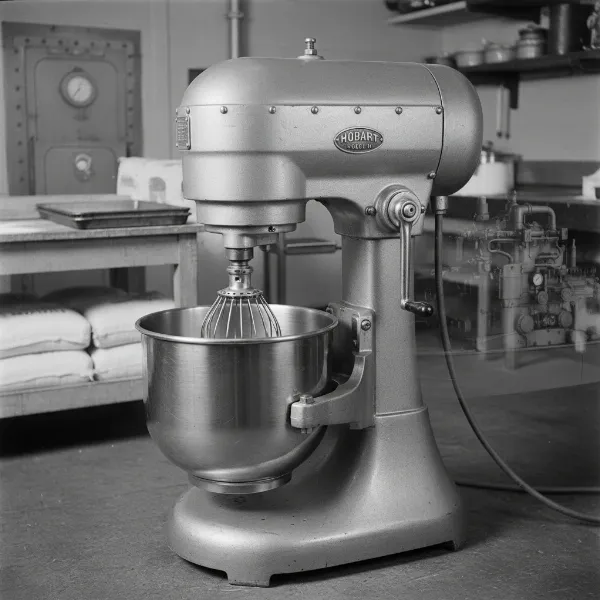 An early 60-quart Hobart industrial mixer used in commercial bakeries and U.S. Navy battleships.
The Birth of a Kitchen Icon: KitchenAid Enters the Home
With the success of their industrial mixers, Hobart began to explore the potential for a smaller, more accessible version for home use. Around 1918, company executives took prototypes of these new mixers home for testing. It was during this phase that a pivotal moment occurred. Legend has it that the wife of one executive, after using the machine, famously declared, “I don’t care what you call it, all I know is it’s the best kitchen aid I’ve ever had!” And with that enthusiastic endorsement, the iconic “KitchenAid” brand was born.
In 1919, Hobart officially introduced the KitchenAid Food Preparer for the home, initially known as the C-10 model. This early residential mixer was a groundbreaking innovation, yet it presented significant challenges for the average household. Weighing a hefty 65 pounds and priced at $189.50 (an astronomical sum, equivalent to over $2,800 or even up to $6,000 in today’s money), it was both cumbersome and prohibitively expensive. Retailers were hesitant to stock such a niche and costly appliance. To overcome this, Hobart pioneered a direct sales approach, assembling a largely female door-to-door sales force to demonstrate the mixer’s capabilities directly to housewives, showcasing its power to liberate them from kitchen drudgery. In 1922, the brand introduced the H-5, a slightly smaller and lighter 5-quart mixer, better suited for home kitchens, though still a significant investment.
Shaping the Future: Design, Competition, and Color
Despite its early innovation, KitchenAid faced fierce competition in the emerging home appliance market. Brands like the Sunbeam Mixmaster gained significant popularity in the 1930s, often offering cheaper alternatives. KitchenAid recognized the need to make its mixers more appealing and affordable without compromising quality.
This era marked another transformative phase for the stand mixer, largely thanks to industrial designer Egmont Arens. In 1936, Arens was commissioned to redesign the KitchenAid mixer, aiming for a more streamlined, elegant, and user-friendly appliance. His visionary work led to the creation of the Model “K” in 1937, which introduced the now-iconic, sleek silhouette that has remained largely unchanged for decades. This model also featured a revolutionary interlocking bowl system, improving stability and ease of use. A testament to Arens’ timeless design, attachments developed for the Model “K” are still compatible with modern KitchenAid stand mixers, a remarkable feat of enduring engineering. The price also became more accessible, dropping to around $55 at the time.
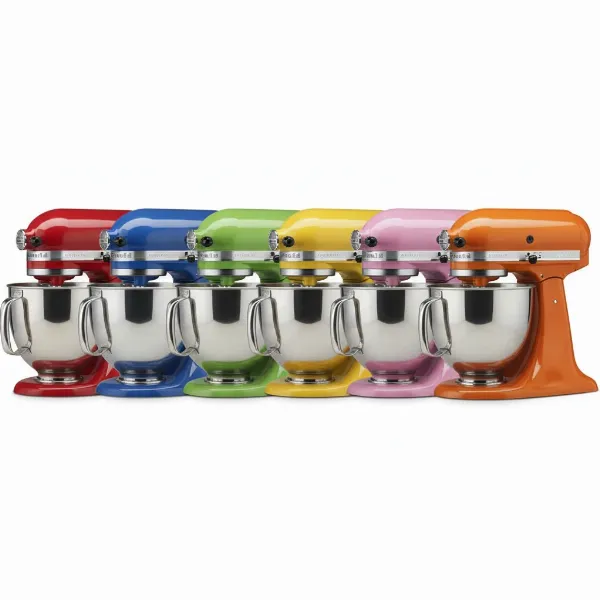
Perhaps one of the most significant aesthetic innovations came in 1955: the introduction of vibrant color options for KitchenAid stand mixers. Moving beyond the traditional white and chrome, these bold colors transformed the stand mixer from a mere utility into a stylish kitchen centerpiece, a statement of personal expression. This decision cemented the KitchenAid stand mixer’s place not just as a reliable appliance, but as a cultural icon and a symbol of sophisticated home cooking.
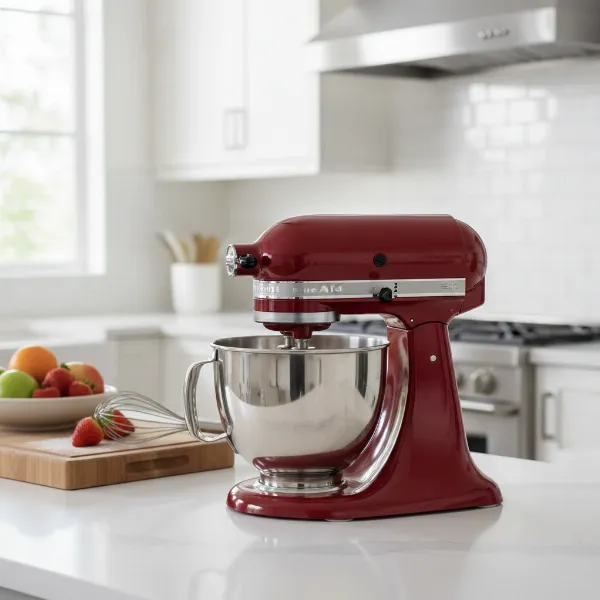 An iconic KitchenAid Model K stand mixer in a vibrant red color, showcasing its timeless design.
The Stand Mixer Today: A Timeless Kitchen Essential
The journey from Hobart’s industrial workshops to the colorful, indispensable appliances gracing modern countertops is a testament to continuous innovation. The KitchenAid brand, acquired by Whirlpool Corporation in 1986, has continued to evolve, introducing a wider range of models, capacities, and advanced features, while largely preserving the classic design and legendary durability.
Today, the stand mixer remains a cornerstone of countless kitchens, empowering home bakers and culinary enthusiasts to create everything from delicate meringues to hearty artisan breads with remarkable ease. Its presence signifies a commitment to quality, a love for baking, and an appreciation for tools that stand the test of time.
Buying Guide: Selecting Your Ideal Stand Mixer
Understanding the history of the stand mixer provides valuable insight into the enduring features and considerations for modern purchases. When choosing a stand mixer, reflect on the core innovations that shaped its development:
- Determine Your Needs: Just as early commercial bakers and naval chefs needed high capacity, consider your usual batch sizes. Are you a frequent bread baker needing robust kneading power, or do you primarily whisk eggs and mix cake batters? This will guide your choice of bowl capacity (from 3.5 quarts for smaller tasks to 7+ quarts for large batches).
- Power and Performance: The evolution from manual to electric, then to powerful planetary action, highlights the importance of motor strength. Look for a mixer with sufficient wattage to handle dense doughs without straining.
- Essential Attachments: The pioneering spirit of early KitchenAid models offering versatile attachments remains a key feature. Ensure your chosen model comes with basic beaters (flat beater, wire whip, dough hook) and consider optional attachments for expanding its functionality.
- Design and Durability: Egmont Arens’ iconic Model K design emphasized both aesthetics and durability. Modern stand mixers often follow this enduring aesthetic, offering robust construction for longevity. While colors are now a standard offering, consider the overall build quality.
- Brand Reputation: The lineage from Hobart to KitchenAid showcases a history of reliability. Research brands known for quality and customer support, often reflected in their history of innovation.
Tips for Using and Maintaining Your Stand Mixer
To ensure your stand mixer serves you well for years, much like the durable early models, proper usage and maintenance are key:
Safe and Effective Operation
- Read the Manual: Always familiarize yourself with your specific model’s instructions. Each mixer has unique guidelines for assembly, speed settings, and attachment use.
- Secure Placement: Always operate your stand mixer on a stable, flat surface to prevent movement, especially during heavy-duty mixing.
- Proper Attachment Selection: Use the correct attachment for the task at hand (e.g., dough hook for kneading, wire whip for aeration, flat beater for general mixing).
- Gradual Speed Increase: Start at a low speed and gradually increase it to avoid splattering ingredients and to allow the motor to adjust smoothly.
- Do Not Overload: Respect the mixer’s capacity limits. Overloading can strain the motor and reduce its lifespan.
|
Our Picks for the Best Stand mixer in 2026
As an Amazon Associate I earn from qualifying purchases.
|
||
| Num | Product | Action |
|---|---|---|
| 1 | Cuisinart SMD-50GPH Precision Pro 5.5-Quart Digital Stand Mixer with 12-Speeds, 3 Preprogrammed Food Prep Settings, Mixing Bowl, Whisk, Flat Mixing Paddle, Dough Hook, and Splash Guard, Graphite |

|
| 2 | Cuisinart Stand Mixer, 12 Speeds, 5.5-Quart Mixing Bowl, Chef's Whisk, Flat Mixing Paddle, Dough Hook, and Splash Guard with Pour Spout, Silver Lining, SM-50BC, Silver Lining |
|
| 3 | Kitchen in the box Stand Mixer,3.2Qt Small Electric Food Mixer,6 Speeds Portable Lightweight Kitchen Mixer for Daily Use with Egg Whisk,Dough Hook,Flat Beater (Black) |
|
| 4 | Kitchen in the box Stand Mixer,3.2Qt Small Electric Food Mixer,6 Speeds Portable Lightweight Kitchen Mixer for Daily Use with Egg Whisk,Dough Hook,Flat Beater (Blue) |
|
| 5 | Cuisinart SM-50G Precision Master 5.5-Quart 12-Speed Stand Mixer with Mixing Bowl, Chef's Whisk, Flat Mixing Paddle, Dough Hook, and Splash Guard with Pour Spout, Agave Green, Manual |
|
| 6 | Cuisinart SMD-50CRM Precision Pro 5.5-Quart Digital Stand Mixer with 12-Speeds, 3 Preprogrammed Food Prep Settings, Mixing Bowl, Chef's Whisk, Flat Mixing Paddle, Dough Hook, and Splash Guard, Cream |
|
| 7 | Cuisinart SPI-50 Spiralizer, White |
|
| 8 | Cuisinart SMD-50BC Precision Pro 5.5-Quart Digital Stand Mixer With 12-Speeds, 3 Preprogrammed Food Prep Settings, Mixing Bowl, Whisk, Flat Mixing Paddle, Dough Hook, And Splash Guard, Silver Lining |
|
| 9 | Kitchen in the box Stand Mixer,3.2Qt Mini Electric Food Mixer,6 Speeds Portable Lightweight Kitchen Mixer for Daily Use with Egg Whisk,Dough Hook,Flat Beater (Green) |
|
| 10 | 3-IN-1 Electric Stand Mixer, 6.5QT Bowl 660W 10-Speed Kitchen Mixer, Household Food Mixers include Dough Hook, Beater and Whisk, Bread Cake Mixer for Baking and Most Home Cooks, Red |
|
Cleaning and Care for Longevity
- Immediate Cleaning: Clean the bowl and attachments immediately after use. Most modern bowls and attachments are dishwasher- safe, but always check the manufacturer’s recommendations.
- Wipe Down the Base: Use a damp cloth to wipe down the mixer head and base, removing any food splatters. Avoid abrasive cleaners.
- Dry Thoroughly: Ensure all parts are completely dry before reassembling or storing to prevent water spots and corrosion.
- Regular Inspection: Periodically check the power cord for any damage and ensure all parts are securely fastened.
Where to Purchase Stand Mixers
Today, finding a stand mixer is easier than ever. You can explore:
- Major Retailers: Large department stores and electronics chains often have a wide selection of models and brands, allowing you to see them in person.
- Online Marketplaces: Websites like Amazon, Best Buy, and directly from brands like KitchenAid or Breville offer extensive choices, often with competitive pricing and detailed customer reviews.
- Specialty Kitchen Stores: Stores focusing on culinary equipment might provide more expert advice and a curated selection of higher-end or specialized models.
When purchasing online, always review product specifications, warranty information, and return policies.
Stand Mixer Legacy: A Culinary Revolution
The stand mixer stands as a testament to how a single invention can profoundly reshape an entire aspect of daily life. From Herbert Johnston’s simple observation to the iconic Model K and its vibrant successors, the journey of the stand mixer is a story of continuous innovation, adapting to the needs of both commercial kitchens and home bakers. It represents not just mechanical progress but a cultural shift towards more efficient, enjoyable, and creative cooking experiences.
Frequently Asked Questions
How did the stand mixer fundamentally change home baking?
The stand mixer revolutionized home baking by automating the most labor-intensive tasks like kneading dough and whipping ingredients. This significantly reduced the physical effort and time required, making baking more accessible and enjoyable for home cooks and fostering greater creativity in the kitchen.
What makes the KitchenAid Model K design so enduring?
The KitchenAid Model K, designed by Egmont Arens in 1937, achieved an iconic status due to its sleek, timeless silhouette, improved stability with an interlocking bowl, and durable construction. Its design was so successful that it has remained largely unchanged, with attachments from this era still compatible with current models.
Were there stand mixers before KitchenAid?
Yes, while KitchenAid popularized the home stand mixer, earlier versions existed. Herbert Johnston invented the electric standing mixer in 1908, and Hobart produced large industrial mixers (like the 60-quart Model H) for bakeries and the U.S. Navy before adapting the technology for household use under the KitchenAid brand in 1919.
What role did women play in the early adoption of stand mixers?
Women played a crucial role in the early adoption of stand mixers. After executives’ wives famously coined the “KitchenAid” name, a largely female door-to-door sales force was employed to demonstrate the expensive and heavy early models directly to housewives, proving the appliance’s value in reducing household labor.
Why did stand mixers become available in different colors?
The introduction of vibrant colors for KitchenAid Stand Mixers in 1955 was a strategic move to enhance their aesthetic appeal. It transformed the mixer from a purely utilitarian appliance into a stylish kitchen statement piece, contributing to its status as a desirable and iconic home item.